"The French Riviera of the East"
Key details about Puducherry's upcoming Legislative Assembly elections
Puducherry is a Union Territory governed under Part VIII of the Indian Constitution and the Government of Union Territories Act, 1963. Unlike a full state, its elected assembly has limited legislative powers, and the Lt. Governor (representing the Central Government) plays a constitutionally significant role. This unique arrangement has historically been a source of political friction between elected Chief Ministers and Lt. Governors.
Understanding the Union Territory's unique political and cultural identity
Puducherry — formerly Pondicherry — is unlike any other political unit in India. A former French colony that was ceded to India in 1954 and formally merged in 1962, it retains a distinctly Francophone soul: cobblestone boulevards lined with bougainvillea, yellow colonial buildings, a thriving café culture, and a governance legacy shaped by the colonial legal and administrative codes that coexist with Indian constitutional norms.
Puducherry's legislative assembly was established in 1963. For most of its post-merger history, the Indian National Congress dominated the assembly. However, the territory has seen significant volatility — governments have fallen multiple times through defection crises, floor crossings, and the unique constitutional tension between elected Chief Ministers and centrally appointed Lt. Governors.
The Dravida Munnetra Kazhagam (DMK) and its ally Congress dominated the 2016 elections. In a dramatic turn, the Congress-DMK government of V. Narayanasamy collapsed in February 2021 — before its term ended — after a series of defections engineered by the opposition. The subsequent 2021 election saw the NDA combine of N. Rangasamy's All India NR Congress (AINRC) and BJP win a narrow majority.
Puducherry's politics is perpetually shadowed by the constitutional ambiguity of the Lt. Governor's powers. Multiple Chief Ministers have publicly clashed with Lt. Governors over administrative appointments, welfare schemes, and governance decisions. The Supreme Court has adjudicated several of these disputes, but the underlying tension between elected authority and central control remains a live political issue heading into 2026.
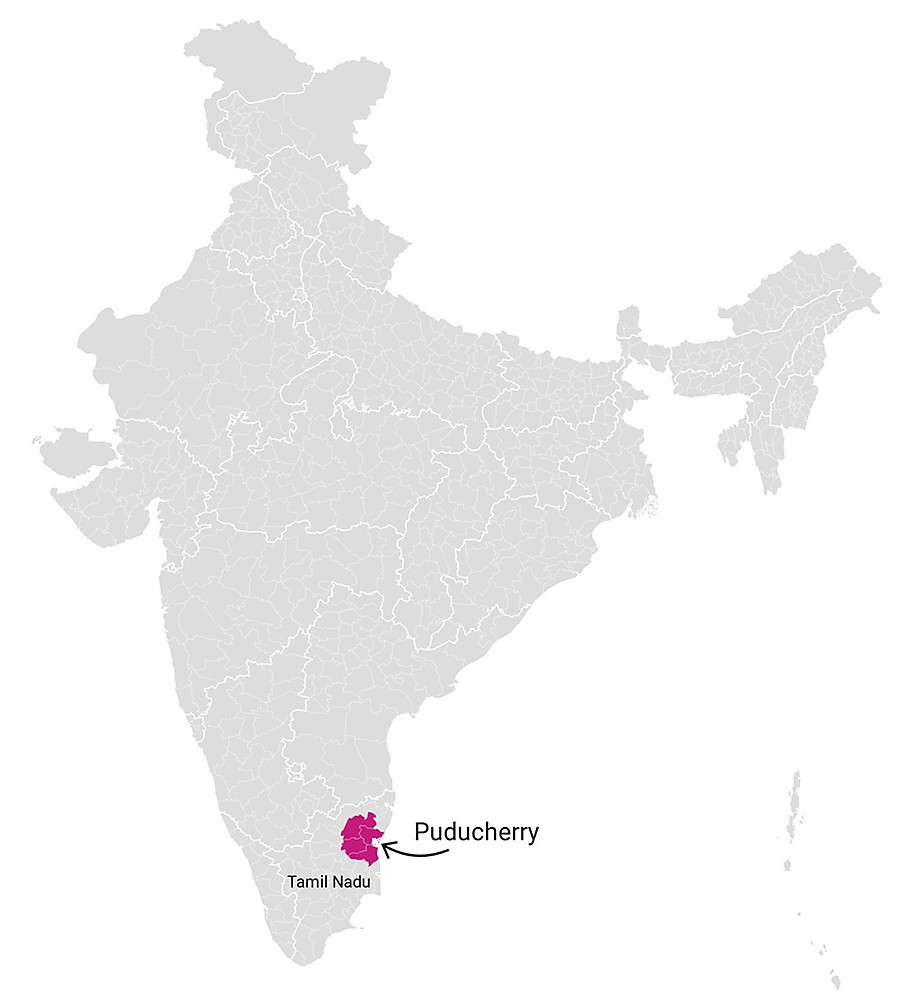
Puducherry is a geographically non-contiguous Union Territory comprising four enclaves in three different states: the Puducherry district (surrounded by Tamil Nadu), Karaikal district (also within Tamil Nadu), Mahé district (within Kerala), and Yanam district (within Andhra Pradesh). All four enclaves vote in the same assembly election, making Puducherry's electoral geography genuinely unique in India.
Puducherry's economy benefits from a vibrant tourism sector, a well-developed industrial area (especially at Ariyankuppam and Karaikal), fishing communities, and a tax and excise structure historically more favourable than neighbouring Tamil Nadu — which has driven significant retail and liquor trade. The Sri Aurobindo Ashram and the international township of Auroville bring a constant flow of spiritual seekers and international residents, adding a cosmopolitan dimension to the local economy.
The 2026 Puducherry elections will be fought on a razor-thin majority basis — the NDA won 16 of 30 seats in 2021. The Congress-DMK combine will seek to recapture power, while the AIADMK's position (aligned with NDA nationally but fragmented locally) adds further complexity. With 30 seats and individual constituency swings capable of flipping the entire government, every ward-level dynamic matters enormously in Puducherry.
Current distribution of seats in the Puducherry Legislative Assembly
All 30 constituencies across Puducherry, Karaikal, Mahé & Yanam enclaves
| No. | Constituency | District / Enclave | Lok Sabha Constituency |
|---|
Critical factors that will shape the upcoming elections
The constitutional tug-of-war between the elected government and the centrally appointed Lt. Governor over administrative powers, transfers, and scheme approvals will remain the defining governance narrative of 2026.
Expanding the industrial corridor at Karaikal, retaining IT investments, and creating sustainable jobs for Puducherry's educated youth — who often migrate to Chennai or Bengaluru — is a central electoral demand.
The long-standing demand for full statehood — to gain greater legislative and financial autonomy, access to central schemes applicable only to states, and an elected government with full executive powers — cuts across party lines.
Free rice, subsidised liquor policy debates, JIPMER's role as a national health institution, and the delivery of welfare schemes amid Lt. Governor interference will all shape voter sentiment in urban and rural segments.
Sustainable development of the French Quarter, Auroville governance disputes, coastal infrastructure, and positioning Puducherry as a premium tourism destination while preserving its heritage character is an emerging electoral issue.
The livelihoods of large fishing communities in Puducherry and Karaikal — affected by cyclones, Sri Lankan naval incursions, and deep-sea fishing regulation — remain a sensitive and politically mobilising constituency issue.