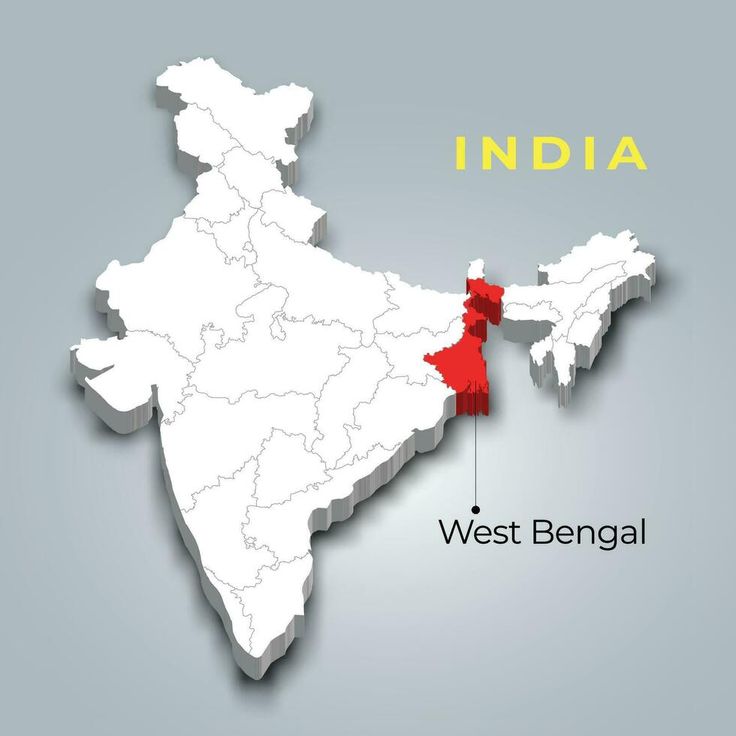
"The Cultural Capital of India"
Key details about West Bengal's upcoming legislative assembly elections
Understanding the state's rich political history and contemporary landscape
West Bengal, home to over 100 million people, is one of India's most densely populated and politically consequential states. From the intellectual heritage of Rabindranath Tagore and the revolutionary tradition of Netaji Subhas Chandra Bose, to the bustling streets of Kolkata — once the colonial capital of British India — the state carries an outsized cultural and political weight in the nation's story.
West Bengal's post-Independence political journey is defined by three dramatic chapters. The Congress era of the 1950s–60s gave way to one of the world's longest-serving democratically elected communist governments: the Left Front, led by the CPI(M), ruled uninterrupted for 34 years (1977–2011). This era saw sweeping land reforms (Operation Barga), panchayati raj deepening, but also stagnation and industry flight in the 1990s.
In 2011, Mamata Banerjee's All India Trinamool Congress swept the Left Front out of power in a seismic electoral upset. The TMC has since won three consecutive Assembly elections — 2011, 2016, and 2021 — making Mamata Banerjee one of India's most durable and combative regional leaders.
The 2021 West Bengal Assembly election was one of the most fiercely contested in Indian electoral history — an eight-phase poll conducted amid COVID-19, with the BJP mounting an unprecedented challenge backed by the central government. The TMC's landslide victory with 213 seats was widely seen as a personal triumph for Mamata Banerjee, who won her own seat from Bhawanipur after an initial defeat in Nandigram. The result cemented her status as the BJP's most potent regional rival.
West Bengal's economy spans agriculture (rice, jute, tea from Darjeeling), manufacturing (jute mills, engineering goods), a significant informal economy, and a growing services sector centred on Kolkata's IT parks and Salt Lake technology corridor. Remittances from the large Bengali diaspora within India and abroad are economically significant. The state is also a major gateway to trade with Bangladesh, Bhutan, Nepal, and Southeast Asia.
With 294 assembly constituencies — the fourth largest state assembly in India — and 42 Lok Sabha seats (third highest), West Bengal is a critical prize in both state and national politics. Its diverse demography includes Scheduled Caste communities (particularly Matua, Rajbongshi, and Namasudra), Scheduled Tribe voters concentrated in Jungle Mahal and North Bengal, a significant Muslim population (~27%), and urban middle-class voters in Kolkata and its suburbs. Each segment responds to distinct political narratives.
The 2026 West Bengal elections will be landmark: can Mamata Banerjee's TMC achieve an unprecedented fourth consecutive term? The BJP, after peaking at 77 seats in 2021, will seek to regroup. The Left Front and Congress, both decimated in 2021, will attempt a revival under the INDIA bloc umbrella. Key battlegrounds include the Jungle Mahal seats in West Midnapore, Bankura & Purulia, the border districts of North Bengal, and the Muslim-majority seats of Murshidabad and Malda.
Current distribution of seats in the West Bengal Legislative Assembly
All 294 constituencies with reservation status & 2021 electorate data
| No. | Constituency | District | Lok Sabha |
|---|
Critical factors that will shape the upcoming elections
Political violence, post-poll violence allegations, and the state of law and order — particularly in rural Bengal — remain deeply charged electoral issues, with both the ruling party and the opposition trading accusations.
Attracting large-scale investment, reversing industrial flight, creating jobs for Bengal's educated youth, and developing the state's IT and logistics sectors will be central campaign promises from all parties.
The political mobilisation of Matua, Rajbongshi, and other SC communities around CAA and NRC, Muslim voter consolidation, and tribal aspirations in Jungle Mahal will all be decisive sub-narratives in 2026.
TMC's Duare Sarkar doorstep welfare scheme, Lakshmir Bhandar income support for women, Swasthya Sathi health coverage, and Kanyashree for girl students will all be defended vigorously and challenged fiercely.
Farmer indebtedness, jute & potato pricing, irrigation access, and cyclone rehabilitation in coastal Sundarbans and South Bengal districts will shape rural voter sentiment critically.
The TMC's combative federalism — withholding central schemes, disputes over MGNREGS funds, governor-CM conflicts, and CBI/ED investigations — will be framed as either standing up for Bengal's pride or governance failure.